
What is your industrial property actually capable of becoming?
Before you sell, lease or redevelop, first understand its true development potential.
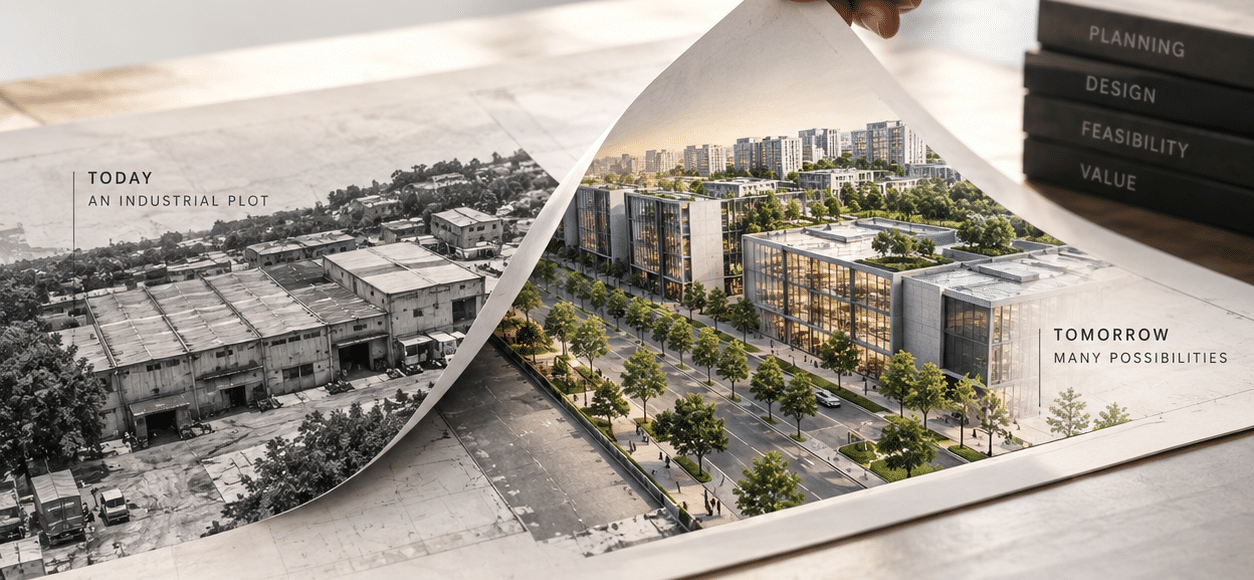
Most owners know what their property is worth today. Far fewer know what it could become tomorrow.
Owners of industrial property tend to know their present use, their existing rent, their current market price, the numbers a broker will quote them. What these figures rarely answer is how much development the land could actually support — whether the existing structure is under-utilising the plot, whether a different use is worth examining, whether future rental income could materially improve, or whether redevelopment justifies the capital it would require.
From existing property to development decision
The study moves in one direction: existing property, the applicable planning framework, development potential, possible uses, built-up and leasable potential, parking and access and services, indicative development cost, potential revenue, development scenarios — arriving, finally, at an informed development decision.
The objective is not to begin by designing a building. The objective is first to establish whether the opportunity deserves to become a project.
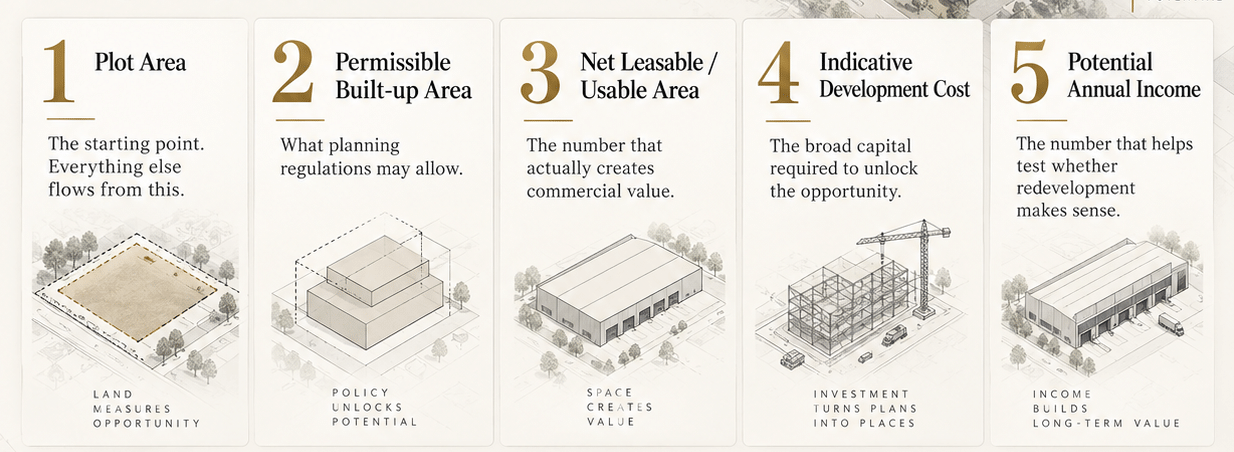
Five numbers every industrial property owner should know
The plot area is the starting point — the fixed quantity everything else is measured against. The permissible built-up area follows from it: what the applicable planning provisions may actually allow. From that, the net leasable or usable area — the portion that creates commercial value, once cores, services and circulation have taken their share. Then the indicative development cost: the broad capital required to unlock the opportunity at all. And finally, the potential annual income — the number that begins testing, in earnest, whether redevelopment makes sense.
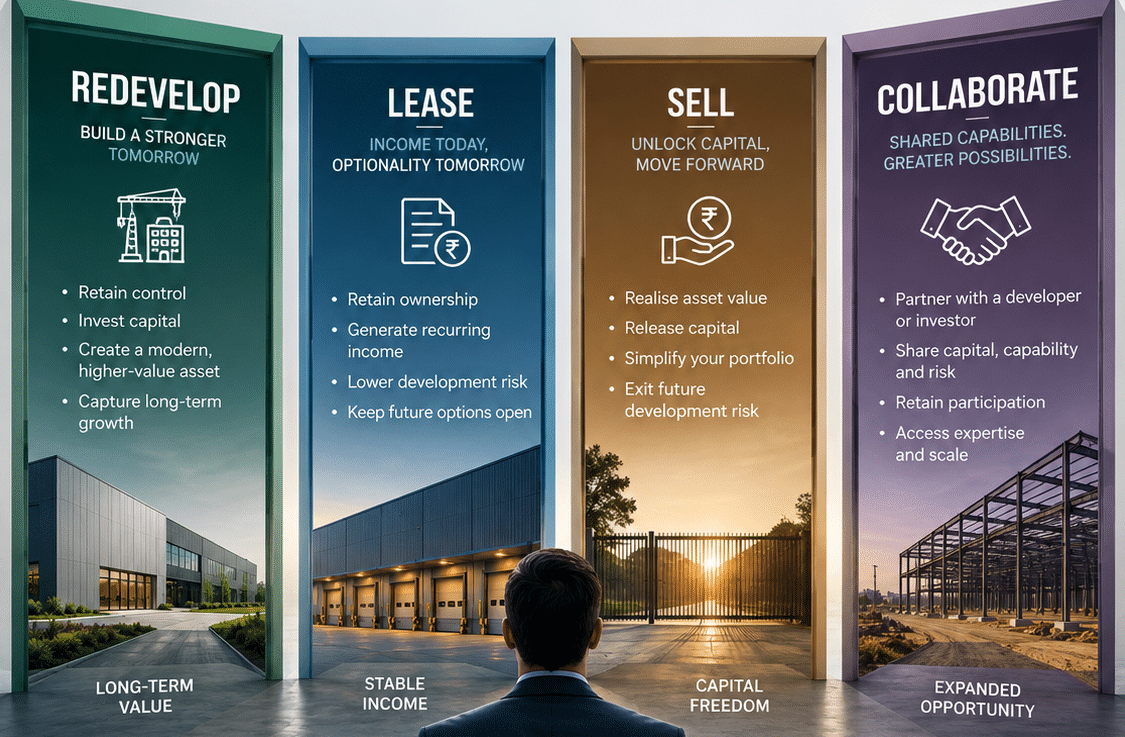
Redevelop. Lease. Sell. Collaborate.
One property can support different strategic outcomes.
To redevelop is to retain ownership and control, commit capital, and build toward a stronger long-term asset. To lease is to retain ownership while prioritising recurring income and reducing direct development exposure. To sell is to release capital, simplify the decision, and exit future development risk entirely. To collaborate is to share capital, expertise and risk with a partner while retaining a stake in what the property becomes.
Fd Design's role is not to assume redevelopment is always the answer. The role is to help the owner understand the paths available before deciding between them.
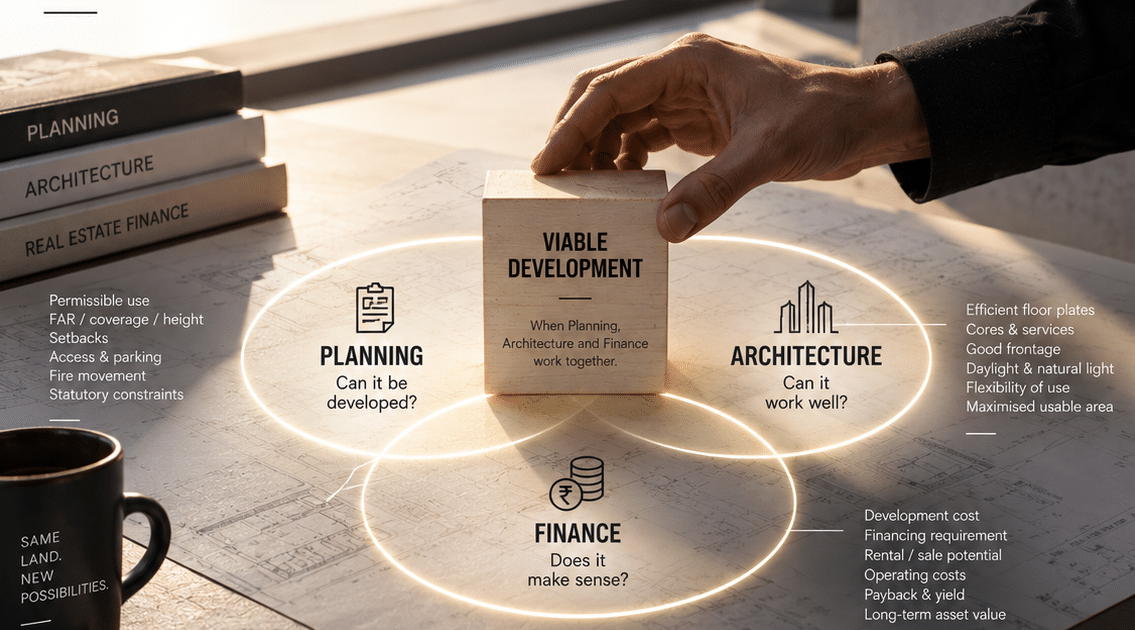
A redevelopment decision should survive three tests
Planning asks whether it can be developed at all — the use, the FAR, coverage and height, setbacks, access, parking, fire movement, the statutory constraints that bound everything else.
Architecture asks whether it can work well — efficiency, floor plates, circulation, cores, services, daylight, flexibility, the leasable area that actually results.
Finance asks whether it makes sense — development cost, capital requirement, rental or sale potential, operating cost, yield, payback, risk, long-term value.
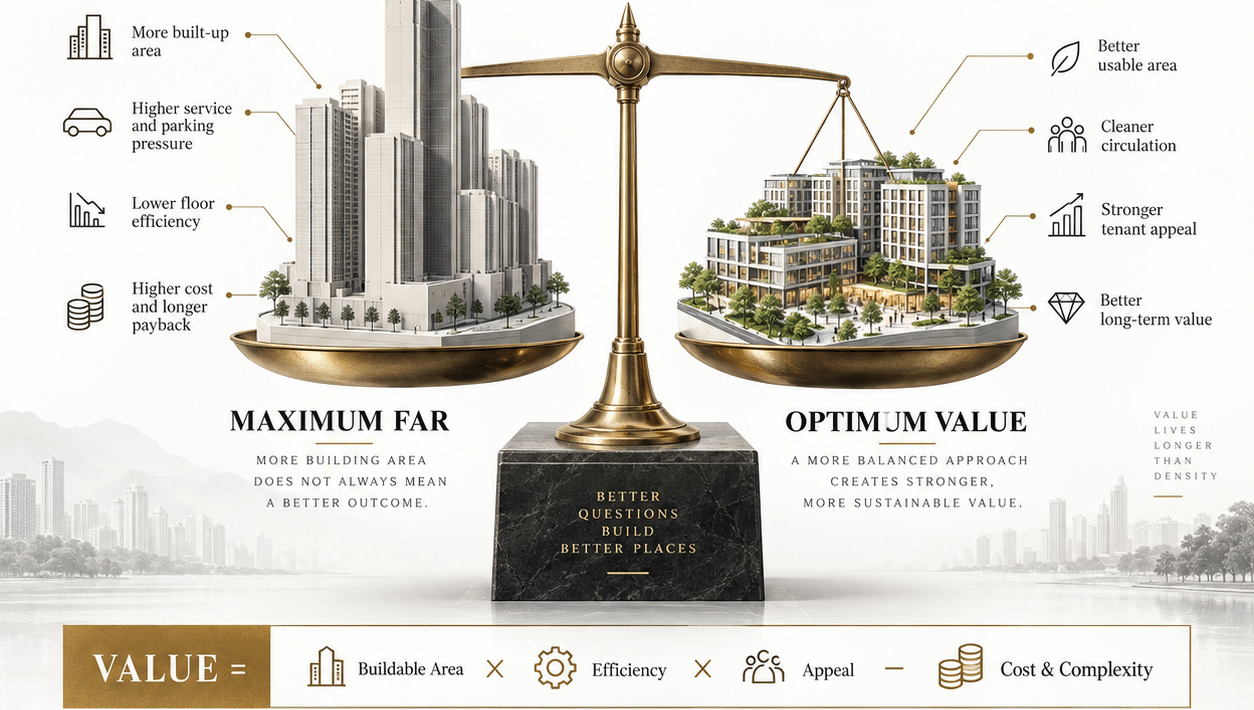
Maximum FAR is not the same as maximum value
More permissible built-up area can also mean greater parking pressure, larger cores, more services, higher construction cost, lower efficiency, a longer payback, weaker commercial performance. FAR tells you how much you may build. It does not tell you how much value you will create.
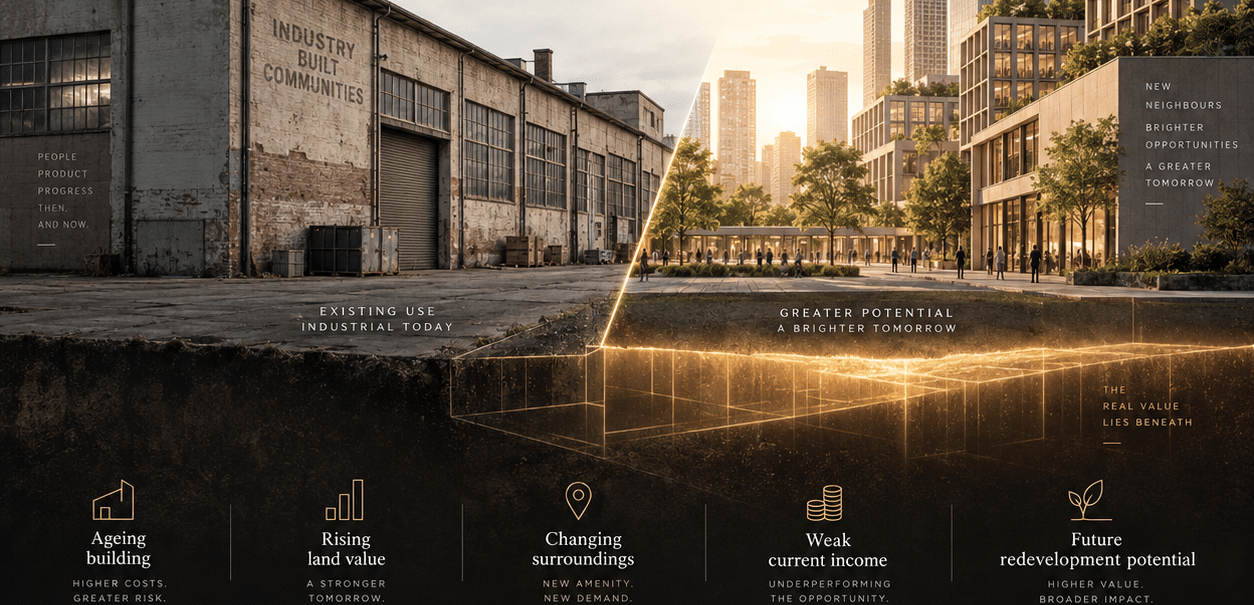
Old factory. Valuable land. When does the equation change?
An ageing building. Under-utilised FAR. A business partly relocated. A present rental yield that no longer reflects the land beneath it. Rising values on every side, changing uses in the neighbourhood, a compliance and maintenance burden that keeps growing, a next generation weighing its own decision, and — quietly, underneath all of it — a stronger possible future income than the current use is producing.
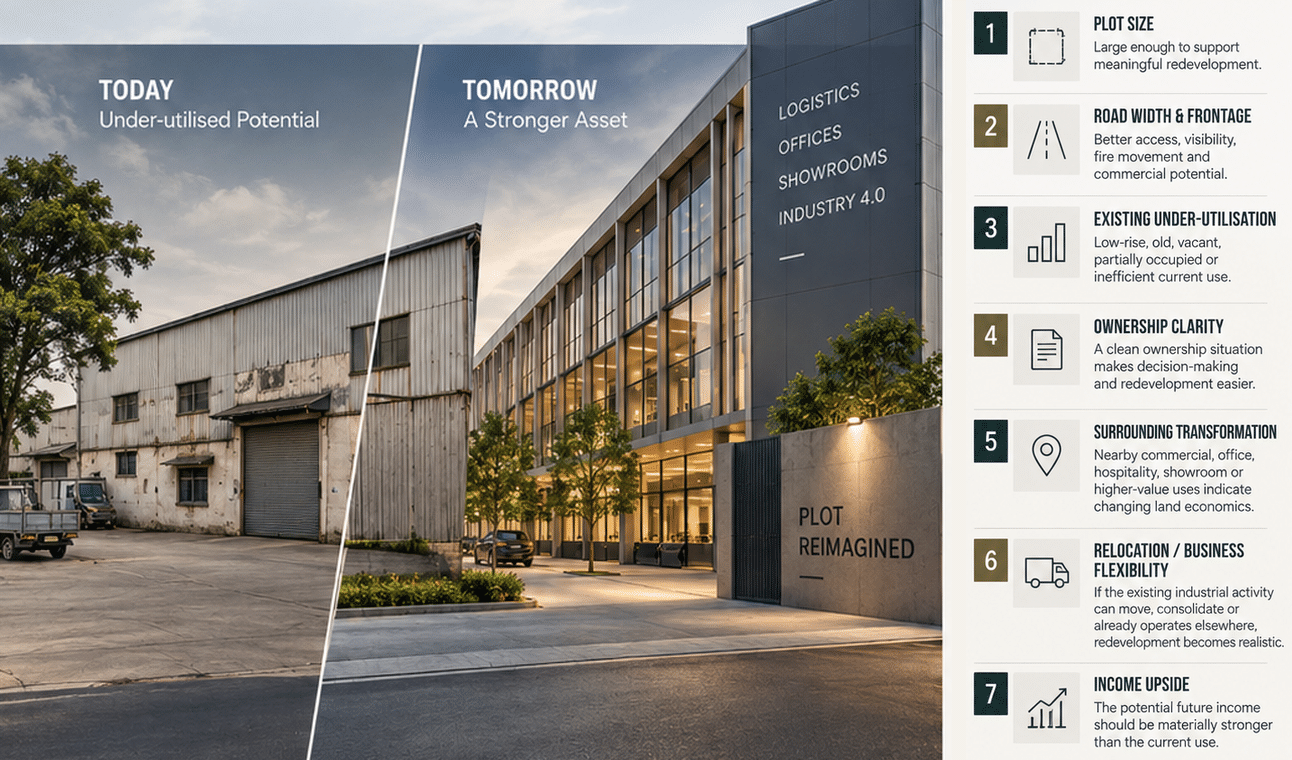
Seven factors worth screening
Plot size. Road width and frontage. The degree of existing under-utilisation. Clarity of ownership. How far the surroundings have already transformed. Flexibility to relocate or phase the existing business. And the income upside itself, once tested against cost.
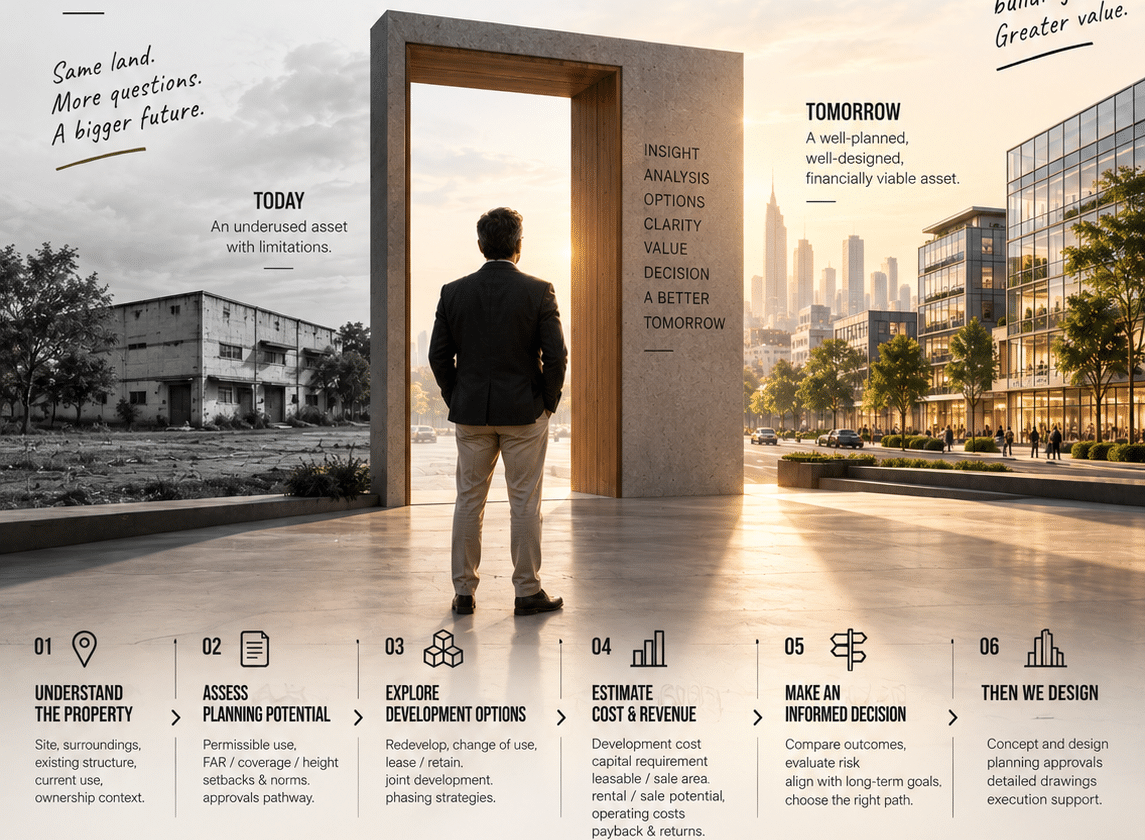
Strategic Development Advisory begins before architecture begins
Property — understanding what exists. Planning potential — understanding what may be permissible. Development options — exploring the alternatives. Cost and revenue — testing commercial viability. Decision — choosing the development direction. Only then, architecture.
We are not starting with “what should we design?” We are starting with “what should this property become?”
Good architecture should come after a good development decision — not in place of one.
Service levels
Preliminary Development Potential Study
For an initial understanding of whether sufficient opportunity exists: a preliminary planning review, broad built-up potential, the range of possible uses, a preliminary look at parking and services, broad cost and income indications, and the key opportunities and constraints the site presents.
Detailed Development Feasibility Study
A deeper study across architecture, planning and commercial viability: the development envelope, schematic layouts, an area statement, alternative scenarios, indicative cost, rental or revenue assumptions, and a broad review of ROI and yield.
Investment & Development Report
For owners, investors, developers, joint-venture partners or financing discussions that require the fuller picture: expanded feasibility work, scenario comparison, financial modelling, a cost-and-revenue framework, development strategy, risk assessment, and a direction for implementation.
Final scope and fee depend on the scale and complexity of the property.
Who this is for
Industrial property owners with ageing or under-utilised assets.
Family-owned industrial businesses, particularly where a second generation is weighing what comes next.
Property investors assessing alternative development scenarios.
Developers and joint-venture partners assessing an opportunity.
Property consultants seeking development clarity for an owner client.
What this service is not
Fd Design's Development Potential Advisory is not a statutory approval, a legal title opinion, a certified valuation, lender-certified financial modelling, brokerage, tax advice, or a guarantee of investment outcome. Where required, specialist legal, valuation, financial, engineering or statutory consultants should be appointed separately.
Start with the property, not the building.
If you own an industrial property and are weighing whether to retain, lease, redevelop, collaborate or sell, the first step may simply be to understand what the asset is capable of becoming.